


Your child scratches until the sheets are spotted with blood. Or you wake every morning with puffy eyes and a blocked nose, even though you hoover and wash at 60°C.
If that sounds familiar, the problem is usually the bed. Dust mites live inside mattresses, pillows and duvets, and the allergen they leave behind sits right where you breathe for eight hours a night. This guide to the best anti allergy bedding in the UK explains what the labels mean, the 7 checks to make before you buy, and what to put on your bed first.
The quick answer: what is the best bedding for dust mite allergy?
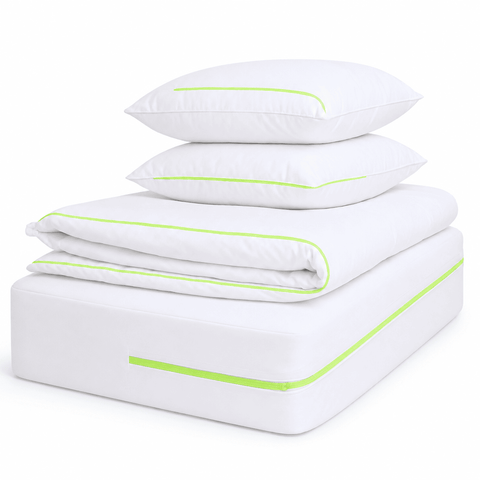
Seal first, then wash. Zip your mattress, pillows and duvet inside dust mite proof protectors with a pore size under 10 microns, so mites and their allergen are sealed away from you. Then put bedding on top that you can wash at 60°C every week, because 60°C is the temperature that kills dust mites. That two-layer setup is what works. A single "anti allergy" duvet or pillow on its own will not fix it.
The rest of this guide shows you how to tell good anti allergy bedding from a label, so you only buy what helps.
Anti allergy, hypoallergenic or dust mite proof: what the labels mean
Bedding shops use three phrases as if they mean the same thing. They do not, and picking the wrong one is the most common reason people spend money and still wake up itchy.
Protectors vs anti dust mite bedding: you need both
This is the question we get on nearly every call. Protectors and bedding do different jobs, and the best anti allergy bedding setup uses both.
Layer 1
Dust mite protectors
5 micron barrier
Where it goes: zipped around the mattress, pillows and duvet.
What it does: seals the mites already living inside your bed away from you and stops new ones getting in.
How often to wash: vacuum or wash about once a month.
Layer 2
Anti dust mite bedding
40 micron weave
Where it goes: on top, as your fitted sheet, duvet cover and pillowcases.
What it does: dust mite resistant and very breathable, and it wicks moisture away so mites are slower to come back.
How often to wash: every week at 60°C.
Think of it this way: protectors deal with the mites already living in your bed, and the bedding stops the top layer you touch from becoming a new home for them. If you only buy bedding, the mattress underneath keeps feeding allergen into the room. If you only buy protectors, your sheets and duvet cover need the same weekly 60°C wash anyway. Our eucalyptus silk is a big part of why both layers feel soft rather than stiff. Read why eucalyptus silk suits dust mite allergy.

Still wondering whether it is worth it? We answer that in anti allergy bedding: does it work?
7 checks before you buy anti allergy bedding
Use this list in any shop, online or on the high street. Tick each one off as you go. If a product fails one, keep looking.
Tick each check as you go.
Anti dust mite bedding, item by item
Here is what to look for on each part of the bed, and what we make for it.
1The mattress
Your mattress holds more dust mites than anything else in the bedroom, so it comes first. You want a zip-sealed encasement that covers all 6 sides, with a pore size under 10 microns. Our anti dust mite mattress protector uses a 5 micron barrier inside soft eucalyptus silk that blocks 100% of dust mites, and comes in deep sizes for mattresses up to 45cm.
Comparing brands? See how the best dust mite protector UK options compare, or read our full mattress protector buying guide.
2The pillows
Your face is on your pillow all night, which makes it the item most linked to morning sneezing and puffy eyes. Zip each pillow inside a protector with the same 5 micron barrier. Our anti dust mite pillow protectors come in sets of 2, so both sides of the bed are covered.
Replacing old pillows as well? Choose ones you can wash at 60°C, like our anti dust mite pillows in 40 micron eucalyptus silk.
3The duvet protector
A duvet is too big to wash at 60°C every week in most home machines, so seal it instead. Our anti dust mite duvet protector zips fully closed and has ties inside each corner, so the duvet stays in place and does not bunch up at one end.
4Anti allergy bed sheets, duvet cover and pillowcases
This is the layer you touch, so it needs to be soft, breathable and washable at 60°C every week. Our Anti Dust Mite Bedding Set includes a fitted sheet, duvet cover and 2 pillowcases in 40 micron eucalyptus silk. The fitted sheet fits mattresses up to 45cm deep.
Only need an anti allergy pillow case? Our anti dust mite pillowcases are sold in pairs.
5The duvet itself
If your duvet is more than a few years old, it is likely full of dust mites and their droppings. A new duvet you can wash at 60°C makes the most of the protector on top of it. Choose our eucalyptus silk anti allergy duvet for a silky, cool feel, or the anti allergy cotton duvet for a classic cotton feel. Both are 9 tog.
Comparing duvets in more detail? See our guide to the best hypoallergenic duvet UK options.

What to buy first if you are on a budget
You do not need everything at once. After more than 1,000 dust mite consultations, this is the order Richard recommends, starting with what makes the biggest difference:
1Mattress protector sealed on all 6 sides.
2A dehumidifier to keep bedroom humidity under 50%, because dust mites need damp air to survive.
3Pillows and duvet protected, and bedding washed at 60°C every week.
4A hard bed frame and hard floors where you can, since fabric headboards and carpet hold dust.
5Extras: a HEPA vacuum, dust mite spray and an air purifier.
For the full breakdown, read what to buy first (and what to skip). If you are not sure whether you need to cover everything, we answer that in is a mattress protector enough on its own?
30 second check
What anti allergy bedding do you need?
How to care for dust mite proof bedding

Bedding (sheets, duvet cover, pillowcases): wash at 60°C every week. This kills dust mites that land on the top layer before they can settle.
Protectors: vacuum or wash about once a month. They stay zipped on the bed the rest of the time.
Drying: no tumble drying. Air dry everything.
Have something that cannot go in at 60°C, like a delicate cushion or soft toy? You can freeze it or soak it instead. Freezing kills dust mites, but it does not remove the allergen they leave behind, so a protector still needs to go on top afterwards.
If you have covers and still have symptoms, one of these care steps is often the gap. Our dust mite covers not working troubleshooting guide walks through the most common ones.
Do dust mite covers for bedding really work?
Yes, when they have a pore size small enough to block allergen and a zip that seals all the way round. Cheap covers often miss one or both, which is why some people try covers and give up. We compare them side by side in cheap protectors vs proper encasements, and explain the science in how do dust mite covers work.
Here is what customers told us after switching:
"The next morning she said it was like sleeping on a cloud. No scratching."
Sal, buying for her daughter
"Previously I was waking up with swollen eyes every day but this has now stopped."
Jess
Frequently asked questions
Do I need to wash or prepare my mattress before putting a protector on?
No. Just put it on and zip it closed. The protector seals in whatever is already in the mattress, so there is no need to clean or treat it first.
Can I keep my own bedding on top of the protectors?
Yes. Put your own sheets and duvet cover on top as normal. Wash them at 60°C every week if the care label allows it, or switch to anti dust mite bedding that does.
Will the fitted sheet fit my deep mattress?
Our standard fitted sheet fits mattresses up to 45cm deep, so most deep mattresses are covered without a special size.
Do you do Super King and deep mattress sizes?
Yes. Protectors come in Single, Small Double, Double, King and Super King, plus King Deep and Super King Deep for mattresses up to 45cm.
What is the difference between a dust mite protector and anti allergy bedding?
A protector has a 5 micron barrier and zips around the mattress, pillows and duvet to seal dust mites away from you. Anti dust mite bedding has a 40 micron weave and goes on top as your sheets and covers, washed at 60°C weekly. The best results come from using both.
Is anti allergy bedding good for eczema?
Dust mite allergen is a common trigger for eczema flare-ups at night. Sealing the bed and using soft, breathable bedding with no chemical treatments can reduce itching and night-time scratching, which is why so many of our customers are parents of children with eczema.
Why trust this guide
This guide was written by Richard Williams, founder of iDustMite and a lifelong allergy sufferer. Richard is an ex NHS worker, was a guest speaker at the Allergy UK Show in 2025 and 2026, and has given over 1,000 dust mite consultations to families across the UK.
5,000+ UK families now sleep allergy free. Not sure what you need? Call Richard on 020 3048 2522.


0 comments