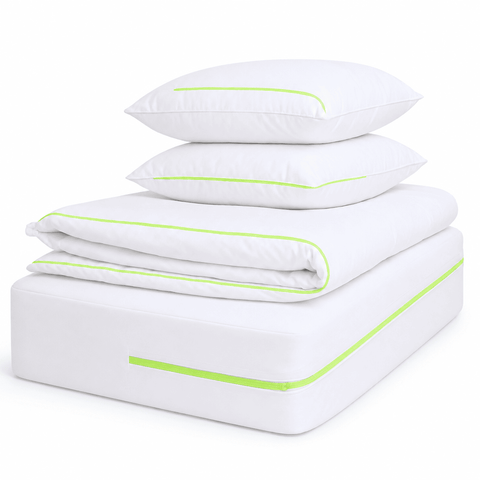
- It must cover all 6 sides and zip shut to an end stop.
- Leave it on for at least 12 months without opening it.
- Pair it with 60°C washing, vacuuming and, for a real infestation, professional treatment.
If you are reading this at midnight with fresh bites on your arms, you are not alone. One of our customers emailed us after ordering an encasement "in a panic over bed bug bites". That is exactly when people buy the wrong thing: a fitted mattress protector that only covers the top. Bed bugs live in the seams, piping and underside of a mattress, so a cover that leaves those open does nothing. This guide shows you how to tell a real bed bug encasement from a normal protector in about two minutes.
Do mattress encasements actually work for bed bugs?
Yes. A properly made encasement does three jobs at once:
- Traps. Bugs and eggs already inside the mattress cannot get out to feed. Bed bugs can survive months without a meal, which is why the encasement stays on for 12 months or more.
- Blocks. New bugs cannot get into the mattress seams, the hardest place to treat.
- Reveals. A smooth, light surface leaves bed bugs nowhere to hide on the bed, so you and your pest controller can see quickly whether treatment is working.
An encasement does not kill bugs in the rest of the room. Think of it as the part of the plan that protects the bed, while washing, vacuuming and treatment deal with everything else. Our step by step plan to get rid of bed bugs shows how it all fits together.
Free checker: will your encasement stop bed bugs?
Tick everything that is true for the encasement you have, or the one you are looking at.

The 7 tests, explained
1. All six sides, not just the top
Most "mattress protectors" are fitted-sheet style: fabric on top, elastic around the skirt, the underside wide open. That is fine for spills, useless for bed bugs. An encasement is a zipped bag your whole mattress goes inside.
2 and 3. The zip is where cheap encasements fail
A bed bug nymph is about 1.5mm long and can squeeze through the tiny hole left at the end of a standard zip. Look for a zip that closes to an end stop or sits under a flap. On our encasement the zip runs the full length and closes to an end stop with no gap.
4. Fabric they cannot bite or crawl through
Bed bugs cannot chew through fabric, but loose weaves and torn seams let them through. Our encasement is woven to a 5 micron barrier. A bed bug egg is roughly 1mm long, many hundreds of times bigger.
5. The right depth
Measure your mattress depth before ordering. An encasement that is too tight puts the zip and seams under strain, which is how splits happen. We make standard 30cm depths and deep versions up to 45cm.
6. Something you will actually keep on
Plastic encasements crinkle and sweat, so people take them off after a few weeks, which lets surviving bugs out. Ours is soft eucalyptus silk with no crinkle, so it is easy to live with for the 12 months that matter.
7. Warranty and certification
You are trusting this cover for a year. Ours comes with a 1 year warranty and OEKO-TEX certified materials.
Encasement vs fitted protector vs spray
| Full-zip encasement | Fitted protector | Bed bug spray | |
|---|---|---|---|
| Covers seams and underside | Yes, all 6 sides | No, top only | Only where sprayed |
| Traps bugs already inside | Yes | No | No |
| Stops new bugs moving in | Yes | No | Short term only |
| How long it works | Years, as long as it stays closed | Not effective | Days to weeks; many UK bed bugs are resistant |
| Best use | Every bed bug plan | Spills and sweat | Alongside other steps, as directed on the label |
How long should you keep a bed bug encasement on?
At least 12 months, without unzipping it to check. Bed bugs can live for months without feeding, longer in a cool bedroom, so opening the cover early can release survivors. After a year, most customers simply leave it on, because it keeps the mattress protected and clean. It also blocks dust mites and their allergens, a useful bonus if anyone at home has allergies.

How to fit a bed bug encasement properly
- Strip the bed and put all bedding straight into a bag, then wash at 60°C.
- Vacuum the mattress, especially the seams and piping, and empty the vacuum outside.
- If you have used a bed bug spray, let the mattress dry fully, as the label directs, before encasing.
- Stand the mattress on its side, slide the open encasement over it and lower it back onto the base.
- Zip all the way round until the zip reaches the end stop. Check it is fully closed.
- Leave it on for 12 months. Check the zip each time you change the sheets.
Size and price finder
Pick your mattress size to see the right bed bug encasement and the full set price.
Mattress only, or the whole bed?
Bed bugs also settle in the filling of pillows and duvets, where washing the cover does nothing. You can either encase those too, or wash the whole pillow and duvet at 60°C every week for at least a month. And if your bed base is a divan or fabric frame, it has seams and staples bugs love.

Bed Bug Mattress Encasement
Full zip, all 6 sides, 5 micron barrier, soft eucalyptus silk.

Bed Bug Protector Set
Mattress, 2 pillows and duvet sealed in one order. Every hiding place on the bed, covered.

Sealed Steel Bed Frame
No fabric, staples or wooden joints for bed bugs to hide in. Wipe clean in 30 seconds.
Questions our customers actually ask
We have had professional treatment. Do we still need an encasement?
Yes, and it is the best time to fit one. Treatment kills what it reaches, but eggs and bugs deep in mattress seams can survive. Encasing straight after treatment traps any survivors and stops the mattress being re-infested. Ask your pest controller when it is safe to put bedding back on, then encase.
We sprayed the mattress with a bed bug killer. Can we put the encasement straight on?
Let the mattress dry completely first and follow the spray label. Then encase. Sprays rarely reach deep into seams, which is exactly why the encasement matters.
Will it also protect against dust mites?
Yes. The same 5 micron barrier keeps dust mites and their allergens out of the mattress, which helps anyone with allergies, asthma or eczema at home.
Can I still use my mattress topper and fitted sheet?
Yes. The encasement goes directly on the mattress. Put your topper on top, then a fitted sheet. If the topper itself may have bugs, hot wash it if the label allows or replace it.
Do I need to throw my mattress away?
Usually not, and dragging an infested mattress through the house can spread bugs. Encasing it is cheaper and safer. If you do dispose of one, wrap it fully in plastic first and mark it as having bed bugs.
Seal the mattress tonight
Full zip, all 6 sides, free next-day UK delivery on orders over £149. Trusted by 5,000+ UK families.
Shop the bed bug encasement Protect the whole bedWritten by Richard Williams, founder of iDustMite, former NHS worker, guest speaker at the Allergy UK Show in 2025 and 2026, and adviser on over 1,000 one-to-one bedroom consultations. Reviewed October 2026.