


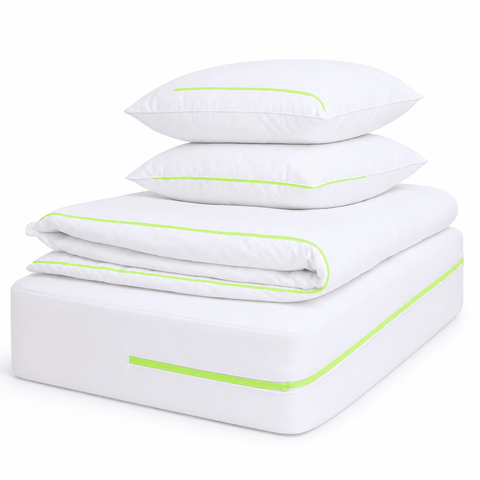
Mattress, pillow and duvet protectors, each sealed with a full zip.
You wake up itching. Your nose is blocked before your feet hit the floor.
You have already spent money on something for the bed, and now you are looking at another product page wondering whether you really need it all.
The question you are actually asking is this: is a mattress protector enough for dust mite allergy, or do you have to seal the pillows and duvet as well?
Here is the honest answer, with the science behind it and the bits nobody else will admit.
The short answer
Protect all three.
The mattress is the biggest single reservoir, but the pillow and duvet sit closer to your face for eight hours a night.
If your budget only stretches to one item, start with the mattress. It holds the most. But treating the bed as three separate purchases is how most people end up disappointed, because the allergens you did not seal are still with you every time you turn over.
Why Your Bed Is the Problem
Dust mites are microscopic creatures that live on the dead skin cells we shed while we sleep. They are not dirty, they are not a sign of a bad home, and hoovering does not reach them.
The thing that actually triggers your symptoms is not the mite itself. It is their droppings.
Each droppings pellet is roughly 10 to 40 microns across. That is small enough to float in the air and land in your eyes, nose and lungs when you move in bed.
Think of a snow globe. Every time you roll over, you shake it.
How the allergen is spread across your bed
A landmark study measured Der p 1, the main dust mite allergen, in each part of the bed separately. It is the clearest picture available of where the problem actually sits.
Mattress 53.8 µg per gram of dust
Highest
Duvet 29.4 µg per gram
About 55% of the mattress
Pillow 13.4 µg per gram
About 25% of the mattress
Source: Siebers et al., 1998, measured across 34 households. It is an older, non UK study, and it remains the most detailed breakdown by item that exists.
Why the mattress matters most
You spend around a third of your life on it, it collects skin cells continuously, and unlike your sheets you cannot put it in the washing machine. It has usually been quietly accumulating for years.
Why the pillow still matters
It holds roughly a quarter of what the mattress holds, but proximity is the issue. A reservoir six inches from your nose does not need to be the biggest to be the one that wakes you up sneezing.
Researchers who examined used pillows also found between 4 and 16 different fungal species living in them, with more variety in synthetic pillows than feather ones.
Why the duvet is the one people forget
Duvets hold roughly double the allergen of pillows, and they create the perfect climate for mites.
Mites cannot drink, so they absorb moisture from the air. You lose water through your skin and breath all night, and the duvet traps that warmth and moisture right where the mites are. This is why room humidity still matters. Keep your bedroom below 50% humidity and the duvet has far less moisture to trap.
What Does Not Work
This is where most articles go quiet. We would rather tell you now than have you waste the money.
1. "Hypoallergenic" synthetic pillows and duvets
This is the big one. The evidence points the opposite way to the marketing.
Synthetic pillows were found to hold around seven times more dust mite allergen than feather pillows. For duvets the gap reached fifteen times.
The reason is the casing, not the filling. Feathers have to be contained by a tightly woven fabric or they poke through, and that tight weave accidentally acts as a barrier. Loose synthetic casings let skin cells in and allergens out. What seals the outside matters far more than what is inside.
2. A standard quilted mattress protector
These cover five sides and stop spills. The underside stays open, so allergens still move in and out freely. Stopping a cup of tea is a different job from stopping a 10 micron particle.
3. Washing at 40 degrees
Laboratory laundry testing found that a 40 degree wash kills fewer than 10% of dust mites. A 60 degree wash kills effectively all of them and removes almost all of the allergen. Eco settings are excellent for the planet and useless for mites.
4. Hoovering the mattress and hoping
It helps at the surface. It does nothing about what is living inside.

So, Is a Mattress Protector Enough for Dust Mite Allergy?
We want to be straight with you here, because the honest answer has two halves.
Half one: nobody has run the trial
No study takes two groups, gives one a mattress protector only and the other a full sealed bed, and compares them. Anyone telling you there is a precise figure is guessing.
Half two: the evidence is mixed
And the reason why is interesting. It comes down to who was studied and how thoroughly the bed was sealed.
A large Cochrane review looked at physical dust mite controls across the general asthma population and found no meaningful improvement in symptoms. That review is real and we are not going to hide it.
But a UK trial that focused specifically on children who were confirmed dust mite allergic, and had recently been to hospital for asthma, found something very different.
Children given proper mite-impermeable bed encasings had a 45% lower risk of needing emergency hospital care over the following year.
Broad populations show little benefit. Confirmed dust mite sufferers with a properly sealed bed show a lot. If you are reading this article, you are almost certainly in the second group.
Allergy UK, for what it is worth, does not sit on the fence. Their guidance is to use barrier covers on the mattress, duvet and pillows, and to wash everything else weekly at 60 degrees.
What a Properly Sealed Bed Actually Looks Like
Four things matter. Miss one and the barrier leaks.
1Six-sided coverage
The protector goes all the way round, including underneath.
2A full zip seal
The zip is what turns a cover into a sealed case.
3A pore size smaller than the allergen
Mite droppings start at around 10 microns, so the fabric has to be tighter than that.
4Breathability
A plastic sheet would block everything and make you sweat all night. The fabric has to let water vapour out while keeping particles in.
The 5 micron versus 40 micron question
This is the single most common question we get on the phone, so here it is plainly.
Protectors
5 microns
Mattress, pillow and duvet encasements
Seal the mites and their droppings inside your existing mattress, pillows and duvet.
Bedding and duvet inners
40 microns
Sheets, covers and pillowcases
Sit on top, stay breathable and comfortable, and wash at 60 degrees.
Protectors do the blocking. Bedding does the comfort. They are not competing products and one does not replace the other. Our protector fabric has been independently pore size tested by a UK laboratory, and you can read the full report here.
Where to Start: The Order We Recommend
This is the order Richard talks customers through on the phone.
- Seal the mattress on all six sides. This is the non-negotiable first step.
- Run a dehumidifier. Keep the bedroom below 50% humidity for around 23 hours a day.
- Deal with the duvet and pillows. Either seal them with protectors or wash them weekly at 60 degrees.
- Swap soft for hard where you can. A hard bed frame instead of a fabric divan, and hard flooring instead of carpet.
- Then add the extras. Vacuuming, anti dust mite spray and an air purifier help, but only once the first four are in place.
Start With Step 1 and Step 3 in One Box
Mattress, pillow and duvet protectors. Six-sided, full zip seal, 5 micron fabric, independently lab tested.
See the Protector Set →The Duvet: You Have Two Honest Options
We are not going to pretend there is only one answer here.
Option A: seal it
Put a 5 micron duvet protector on the duvet you already own.
Option B: wash it
Own a duvet you can genuinely wash at 60 degrees every few weeks.
Option B works, and if you have a single or double duvet and a decent machine, take it.
The practical problem is size. A king or super king duvet will not tumble properly in a standard 7kg to 8kg domestic machine, which means it never actually gets washed at 60 degrees. That is the real reason most people end up sealing the duvet rather than laundering it.
If you would rather wash than seal, our eucalyptus silk duvet is built for exactly that.
Looking After It
Sealed bedding is low maintenance, which surprises people.
Bedding on top: wash weekly at 60 degrees.
Protectors: wash or vacuum every 1 to 3 months. They are sealed, so they are not collecting much.
No tumble drying. Air dry.
No prep needed. Do not wash your mattress first. Just fit the protector.
Why Trust Us on This
NHS doctors have bought our protectors for their own beds.
Not as a sponsorship, as customers.
Our fabric has been independently laboratory tested for pore size, our materials are OEKO-TEX certified, and you can see all of the evidence together on our science and certifications page.
If you want to talk it through with a person before spending anything, call us on 020 3048 2522. We would rather you bought the right thing once.



0 reacties